
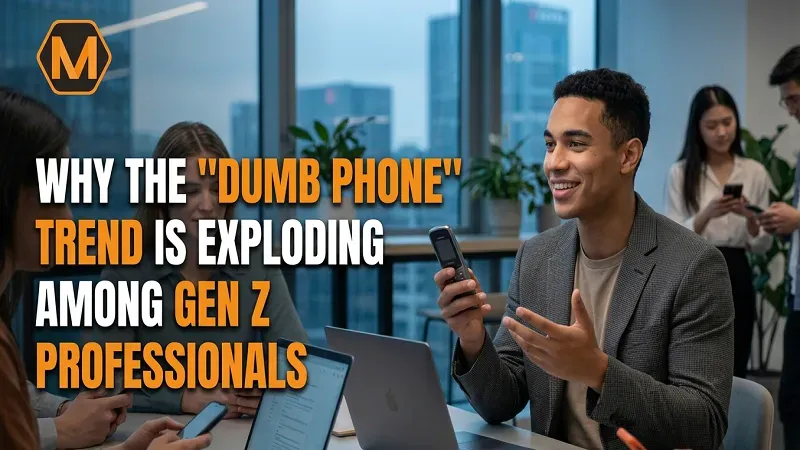
The hypnotic glow of the smartphone screen is slowly losing its grip. For more than a decade, modern life revolved around having everything in the palm of your hand: social media, instant notifications, endless entertainment, and apps for nearly every daily task. Yet in 2026, a surprising shift is emerging in workplaces, tech communities, and creative industries. Many Gen Z professionals, a generation raised in the digital world, are intentionally replacing smartphones with simpler devices known as “dumb phones” or feature phones.
Unlike modern smartphones, these devices are limited to essential functions such as calling, texting, and basic navigation. While some may view this trend as nostalgia or a fashion statement, the reality is far more practical. For many young professionals, switching to a simpler phone has become a conscious lifestyle choice aimed at improving focus, reducing stress, and reclaiming control over their time, especially in a world where even productivity-related searches like “pay someone to do your assignment” reflect how overwhelmed people can become with academic and professional workloads.
Today’s work culture is filled with nonstop digital demands. Notifications arrive constantly through emails, messaging platforms, and workplace apps, often blurring the line between personal and professional life. This always-connected environment has contributed to growing levels of digital fatigue and mental burnout among younger workers. In response, many are reevaluating their relationship with technology and searching for healthier boundaries.
Choosing a basic phone is one of the boldest ways to create those boundaries. By removing constant access to social media and endless scrolling, Gen Z professionals are intentionally reducing distractions and creating more space for productivity, mental clarity, and genuine personal time. What may seem like a step backward in technology is, for many, a step forward in achieving balance.
The Cognitive Cost of Notifications
Modern workdays are increasingly fragmented by digital interruptions. Messages, alerts, and updates arrive continuously, breaking concentration before it can fully stabilize. Cognitive science refers to this as the task-switching cost, the mental penalty paid each time the brain shifts from one task to another.
Research has shown that regaining full focus after a single interruption can take more than 20 minutes in complex tasks. When multiplied across dozens of daily notifications, the loss of productivity becomes significant.
[Smartphone Notification]
│
▼
[Distraction / Mindless Check] ──► (Triggers Task-Switching Cost)
│
▼
[Brain Focus Interrupted] ──► (Takes ~23 Minutes to Return to Deep Work)
Recognizing this pattern, many young professionals are deliberately reducing their exposure to high-frequency digital interruptions. One of the most effective solutions they are adopting is surprisingly simple: removing the source of distraction entirely.
Reclaiming the “Dopamine Menu” Through Digital Detox
The concept of a digital detox once referred to occasional breaks from screens, often during vacations or retreats. In 2026, however, it has evolved into a daily cognitive strategy used by professionals who want to maintain mental clarity in a high-speed information environment.
Rather than consuming a constant stream of algorithm-driven content, many individuals are restructuring their habits into what wellness experts describe as a “dopamine menu,” intentional choices that prioritize stable, meaningful stimulation over chaotic digital input.
Why Minimalist Hardware Changes Behavior
Tactile separation: Physical flip phones or button-based devices require deliberate action, which reduces unconscious checking habits.
Intentional friction: Slower input methods naturally discourage unnecessary communication and encourage more thoughtful engagement.
Reduced decision fatigue: Without dozens of apps competing for attention, the mind experiences fewer micro-decisions, supporting calmness and focus.
Over time, removing high-stimulation digital environments can help stabilize attention patterns. Many users report feeling less reactive, more present in daily interactions, and more creatively focused. Instead of spending hours in algorithm-driven cycles, they redirect attention toward reading, exercise, and face-to-face social interaction.
The Distraction-Free Tech Stack: High-Performance Minimalism
Adopting a basic phone does not mean abandoning modern life or professional responsibility. Instead, it reflects a growing trend of tech compartmentalization, separating work tools from personal communication devices.
In this model, laptops and desktops serve as dedicated work environments for high-performance tasks, while mobile phones are reduced to essential communication only.
Professionals embracing this approach often use minimalist devices such as the Light Phone 2, Punkt phones, or modern Nokia-style feature phones. These devices prioritize functionality over stimulation, often using monochrome or e-ink displays with no apps, feeds, or algorithmic content.
The result is a device that no longer competes for attention simply because it offers nothing designed to capture it.
This shift supports what many describe as high-performance minimalism, where digital tools are intentionally limited to preserve focus, clarity, and long-term cognitive energy.
Strategic Comparison: Smartphones vs. Feature Phones
To understand how this behavioral shift affects daily productivity and cognitive energy, it is useful to compare smartphones and feature phones across key lifestyle and performance categories.
| Lifestyle & Productivity Category | Modern Smartphone | Minimalist Feature Phone (“Dumb Phone”) |
|---|---|---|
| Primary Communication Style | Instant, multi-channel (apps, messaging, video calls) | Direct and simple (voice calls, SMS) |
| Average Daily Screen Time | 4–6+ hours, often mixed with passive scrolling | Under 30 minutes, purpose-driven use |
| Cognitive Load | High, due to constant notifications and app switching | Very low, device remains inactive most of the time |
| Deep Work Capability | Fragmented attention due to interruptions | Extended focus periods with minimal disruption |
| Work–Life Boundary | Blurred, work apps remain constantly accessible | Clearly separated between devices and environments |
| Battery Life | Typically 12–24 hours | Several days (3–7+ days), reducing daily dependency |
The contrast highlights a fundamental difference in design philosophy: smartphones are optimized for engagement, while feature phones are optimized for utility. This distinction directly shapes how users allocate attention, manage time, and structure their workdays.
The Cultural Status Symbol of Being Unreachable
In an unexpected cultural reversal, the simple feature phone has begun to emerge as a subtle status symbol among younger professionals. Where once success was associated with owning the latest high-performance smartphone, today a growing segment of Gen Z views digital minimalism and even partial disconnection as a sign of control and maturity.
Being “unreachable” is increasingly interpreted not as unavailability, but as intentional boundary-setting. It communicates that an individual’s time is structured, their attention is protected, and their availability is selective rather than constant.
This shift reflects a broader change in workplace values, where focus and cognitive clarity are becoming more valuable than constant responsiveness.
The Digital Separation Model
+————————————————————-+
| THE DIGITAL SEPARATION MODEL |
+————————————————————-+
| WORK STATION (Laptop/PC) | PERSONAL SPACE (Dumb Phone)|
| – High-level Strategy | – Voice Calls Only |
| – Complex Data & Research | – Direct SMS Texting |
| – Controlled Communications | – Offline Navigation Maps |
+————————————————————-+
| RESULT: Deep Focus at Work | RESULT: True Mental Rest |
+————————————————————-+
This model illustrates a growing behavioral strategy among digital professionals: separating high-intensity cognitive work from low-stimulation personal communication tools.
A Quiet Rejection of the Attention Economy
Beyond productivity, this shift also carries cultural and philosophical weight. Many young professionals are consciously stepping away from devices designed around surveillance, engagement tracking, and behavioral optimization.
Choosing a simplified device becomes a form of digital boundary-setting, a way to reclaim autonomy over attention and reduce exposure to algorithm-driven influence.
In this context, the feature phone is not just a tool. It represents a broader statement: that focus, privacy, and time are personal resources that should not be continuously negotiated with technology platforms.
Long-Term Benefits for Career Growth and Well-Being
The long-term benefits of adopting a more analog-leaning mobile lifestyle extend well beyond short-term stress reduction. Professionals who actively protect their attention span are building a significant advantage in today’s competitive knowledge economy. While many individuals struggle with fragmented focus and constant digital interruptions, users of minimalist devices are training their minds to sustain deeper, more analytical, and more strategic thinking over extended periods.
Beyond productivity, there are also meaningful physical and mental health benefits. Reduced exposure to blue light in the evening can improve sleep quality, while lower screen dependency often leads to decreased eye strain, reduced neck tension, and healthier posture. Over time, these small improvements contribute to better overall well-being and help reduce the risk of early-career burnout.
More broadly, the growing adoption of feature phones among young professionals reflects a shift toward more intentional technology use. Rather than rejecting modern tools entirely, this approach emphasizes selective usage and conscious digital boundaries. It signals a move away from automatic technological dependence toward a more controlled and balanced relationship with devices.
In this context, the feature phone is not a regression in innovation; it represents a redefinition of how technology fits into human life. For many Gen Z professionals, closing a flip phone at the end of the day is not about disconnection, but about reclaiming focus, clarity, and long-term productivity.
Frequently Asked Questions
What is a “dumb phone”?
A dumb phone, also known as a feature phone, is a basic mobile device designed for essential communication. It typically supports voice calls, SMS texting, and limited utilities such as basic navigation, while excluding advanced smartphone features like social media apps, app stores, and algorithm-driven content feeds.
Why are young workers choosing these devices?
Many young professionals are adopting feature phones as a strategy to reduce digital distractions and prevent burnout. By eliminating constant notifications and infinite scrolling, they can better protect their attention, improve focus, and create clearer boundaries between work and personal life.
How do people manage work tasks without a smartphone?
Most users rely on laptops or desktop computers as their primary work hubs. These devices handle communication, research, and productivity tasks. The feature phone is reserved for essential communication only, ensuring that professional responsibilities remain tied to the workstation rather than following them everywhere.
Does switching to a basic phone mean being completely disconnected?
No. It does not eliminate communication; it simplifies it. Users remain reachable through phone calls and text messages, but remove non-essential digital noise such as social media alerts, promotional notifications, and constant app-based interruptions.
About the Author
The article reflects research and analysis on digital behavior trends, workplace productivity, and evolving technology habits among younger professionals.